“Far more fossil fuels are owned in public markets than we can possibly ever use. That’s the carbon bubble. ”
— Mark Campanale
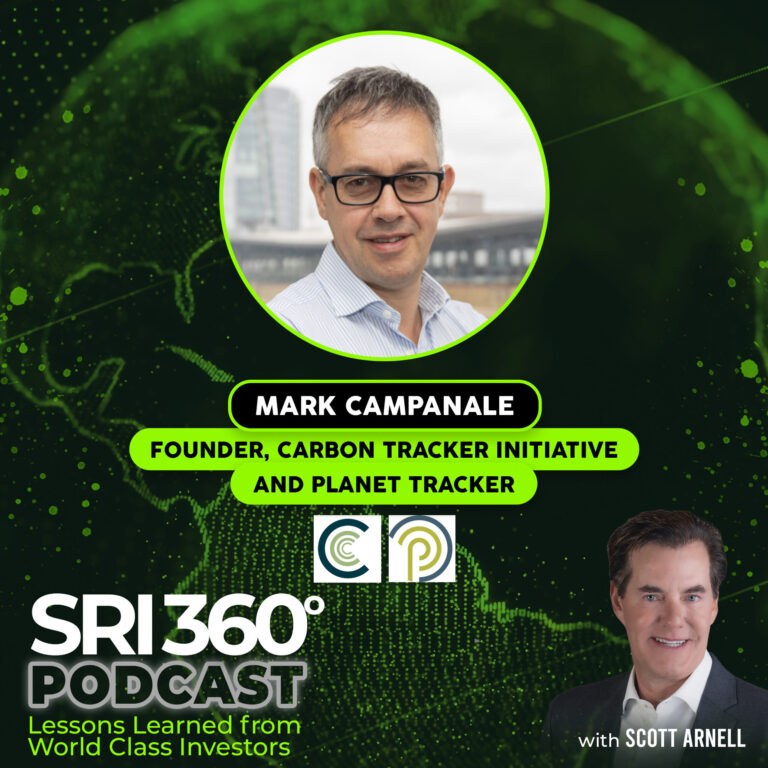
In this episode, I talk with Mark Campanale – founder of Carbon Tracker and Planet Tracker, best known for introducing one of the most disruptive ideas in climate finance: the carbon bubble.
Mark’s story starts in the back of a truck, crossing the Sahara. He was 21, just out of university with a degree in politics and economic history, and found himself in a famine camp in West Africa.
It was disorienting. Unforgettable. Not just because of what he saw, but because of what it made visible: how capital flows, policy decisions, and global poverty are tied together – and how the system wasn’t working for the people who needed it most.
That experience planted a seed – and over the next two decades, that seed kept growing. In the late 80s and early 90s, Mark was based in Nairobi, working with fair-trade cooperatives across East Africa and helping smallholder farmers access global markets.
By the early 2000s, he’d made his way into the City of London. At Jupiter Asset Management, he helped launch the Jupiter Ecology Fund – one of the UK’s first green investment vehicles, focused on companies tackling environmental challenges.
A few years later, he pitched the idea for a Social Stock Exchange – a public market where social and environmental impact weren’t afterthoughts, but central to the business model. He secured a grant from the Rockefeller Foundation and brought it to life, serving as its founding CEO.
But over time, the mission drifted. And Mark stepped away. “It sort of lost its purpose for me,” he said.
Around the same time, he began noticing a strange blind spot in the markets. He was reviewing prospectuses from oil and gas companies raising billions in London. These were 300-page documents laying out growth plans – and yet climate change barely showed up. “In a 300-page prospectus, it was down to like 7 or 8 lines,” he said.
That raised a bigger question: how much of the world’s carbon problem is sitting on the balance sheets of listed companies?
No one could answer that. So he did the math.
He teamed up with Nick Robins – an old friend from his Jupiter days – and a young researcher named James Leaton. Together, they launched a nonprofit and wrote a report. The original title didn’t land. But the night before publishing, they changed it to something that hit harder: Unburnable Carbon.
The idea was simple – and terrifying.
We have a finite carbon budget if we want to stay under 2°C of warming. But the reserves held by fossil fuel companies – already financed, already capitalized – far exceeded that budget.
Mark compared it to a game of musical chairs – but the players were oil majors, national oil companies, and gas producers, all scrambling for the planet’s last remaining carbon budget. There weren’t enough seats for everyone to win.
That meant much of the fossil fuel industry’s projected value was based on resources the world couldn’t afford to burn. If countries kept their climate promises, those reserves would stay in the ground. And markets weren’t ready for that.
The report didn’t just land. It exploded.
Some of the world’s most influential journalists picked it up. Then Rolling Stone turned it into a headline – Global Warming’s Terrifying New Math. The phrase carbon bubble went global. University campaigns kicked off.
Lord Nicholas Stern, the UK economist behind the landmark Stern Review, said he wished he’d written it. The Financial Times ran a feature. Even analysts at JP Morgan and Goldman Sachs asked Mark to come in and brief them.
Mark hadn’t meant to start a movement. But once the idea caught fire, he realized it needed structure – something that could translate the science into financial language the markets would take seriously.
So he built an independent research group focused entirely on that task. What began as a single report became Carbon Tracker – now a full team analyzing over 75 companies – from oil majors to utilities – using a traffic-light system to assess whether their business plans align with the goals of the Paris Agreement.
Their reports are downloaded tens of thousands of times each month by banks, pension funds, and regulators. They’re not campaigners. They’re research analysts, speaking the language of markets and translating climate risk into financial terms.
One of their biggest impacts is that the industry’s reserves life has fallen from 50 years to just 23. It didn’t happen by accident. It happened because investors stopped believing those reserves would ever be developed.
The idea of “stranded assets” has since spread far beyond fossil fuels. In 2018, Mark launched a second initiative – Planet Tracker – to apply the same forensic lens to oceans, land use, and natural resource systems. They’ve uncovered 220 listed seafood companies, most offering little to no transparency, and started pressing the food system with the same kinds of questions Carbon Tracker brought to energy.
Mark never set out to disrupt the system. But by following the numbers others ignored, he uncovered a deeper conflict between how financial markets work – and what the future of the planet really needs.
He’s convinced that change must come from capital markets – not just because they fund the problem, but because they’re one of the few systems fast and powerful enough to course-correct.
What began as a single report has grown into two organizations shaping how trillions move through the global economy – and forcing markets to confront risks they once ignored.
He’s not the loudest voice in the room. But his work has made some of the most powerful institutions take a second look.
Listen in for the full story.
Listen to the episode on Apple Podcasts, Spotify, Overcast, Podcast Addict, Pocket Casts, Castbox, YouTube Music, Amazon Music, or on your favorite podcast platform. You can watch the interview on YouTube here.



What was your favorite quote or lesson from this episode? Please let me know in the comments.
SHOW NOTES:
[00:00] Introduction
[04:09] Mark’s immigrant background and early London upbringing
[12:03] York degree in politics inspired by a random park chat
[14:40] Journey across the Sahara and awakening to global inequity
[18:23] Shifting from charity models to sustainable capital solutions
[23:23] Founding Jupiter Ecology Fund and early ESG investing
[35:29] Founding Social Stock Exchange for impact investing
[44:47] Launch of Carbon Tracker Initiative
[51:37] Accidental virality of the Unburnable Carbon report
[54:34] Carbon Tracker’s theory of change
[01:05:27] Carbon Tracker’s traffic light assessment explained
[01:09:40] The Vatican event and Pope’s bold remark
[01:14:15] Stranded assets concept
[01:17:26] Markets continue financing fossil expansion despite clear climate risks
[01:24:07] Planet Tracker’s focus on land, oceans, and food systems
[01:28:30] Climate solutions exist – but it’s a race against time
[01:37:48] Rapid-fire questions
Additional Resources:
MORE QUOTES FROM THE INTERVIEWS:
“Carbon Tracker is not an advocacy organization. We’re not a divestment campaigning organization. We’re a risk management and opportunity organization. ”
— Mark Campanale
“The whole point of investing is to help companies grow and succeed – not just to trade shares of the top 100 companies in the world. ”
— Mark Campanale