“Even for people facing extremely tough life circumstances, if you have the right combination of support, mentorship, and a little luck, you can create a different outcome – and a different story. ”
— Jonathan Hirschtritt
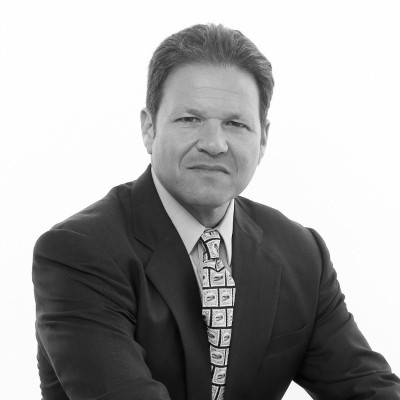
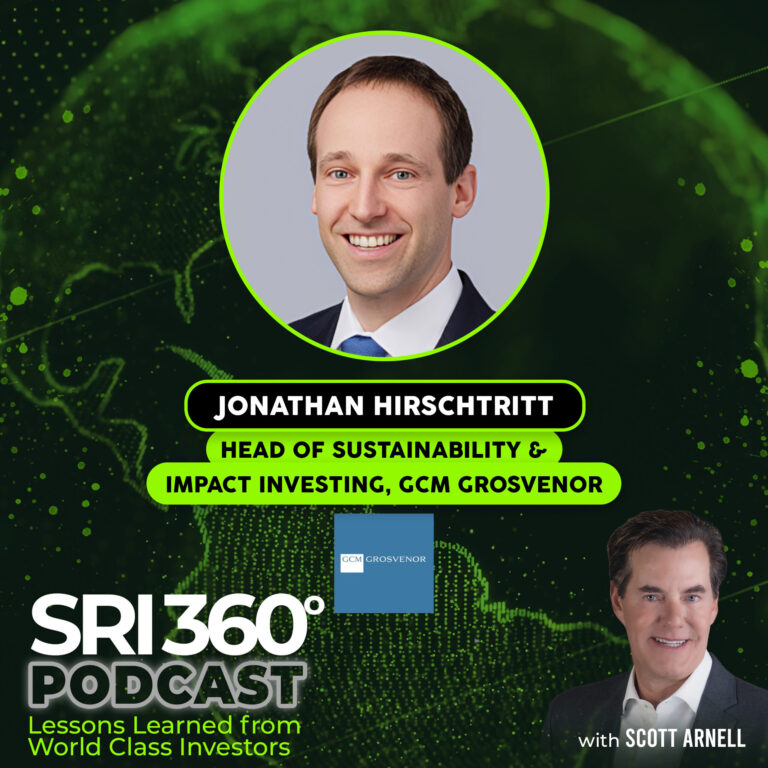
In this episode, my guest is Jonathan Hirschtritt, Head of Sustainability & Investment at GCM Grosvenor – a leading global alternative asset manager for more than five decades.
The firm manages over $80 billion across the full spectrum of alternatives – private equity, infrastructure, real estate, credit, strategic investments, and absolute return strategies – and has built one of the most comprehensive impact and sustainability investing platforms in private markets.
Jonathan grew up in Manhattan. He went to private school, surrounded by opportunity from a young age. But that privilege was punctured early.
When he was just five years old, his mother passed away from cancer – an event that left a permanent mark and shaped much of what would come next. As he said, “You don’t know what grief is at that age. But you know that something is missing.”
His grounding came from his father – a kid from the Bronx who sold newspapers on street corners, went to City College because it was free, and hustled his way into NYU Law on a partial scholarship. He co-founded a law firm with a classmate and built it over more than three decades.
But he never let success erase where he came from. Even when money wasn’t tight anymore, he would turn off lights in the house to save on the electric bill – a quiet reminder that nothing should ever be taken for granted. That instinct – to work hard, stay humble, and pay attention to the small things – never left Jonathan.
Jonathan considered a career in law and explored baseball operations – he even interviewed with the Mets – but his path ultimately went in a very different direction.”
He studied Diplomatic History at the University of Pennsylvania – a mix of history and political science, with a focus on geopolitics – and landed at Bear Stearns just in time to watch it fall apart. His first job was working on leveraged hotel deals, right before the crash. Basically, he had a front-row seat to excess.
After that, it was hedge funds, distressed debt, event-driven equity, and then private equity. He joined Davidson Kempner, then became a partner at Sheffield Asset Management. The work was intense. High-performing. Operationally hands-on.
But over time, something started to shift. “I wanted my capital to matter.”
In 2017, Grosvenor brought him in to work on strategy and operations, later moving into the role of Deputy COO. Four years later, leadership asked him to take on something very different: to formalize and build Grosvenor’s sustainable and impact investing platform. The firm already had a long history with underrepresented managers and other initiatives, but this mandate meant creating a dedicated team, new frameworks, and a full reporting system from scratch.
“This was a brand new area… no one really had done impact reporting or sustainable reporting compared to financial reporting.”
Today, Jonathan runs Grosvenor’s sustainable and impact platform – representing roughly a third of the firm’s AUM. It’s spread across private equity, infrastructure, credit, and real estate.
It’s a returns-first model, fully discretionary, but built to be customized. In fact, more than 70% of Grosvenor’s capital is deployed through separate accounts designed around a client’s specific objectives – whether that means climate, affordable housing, labor outcomes, or education.
Jonathan is clear-eyed about what counts and what doesn’t. He makes a sharp distinction between “sustainable” and “impact,” and for him it comes down to two things: intentionality and measurement. In short, if a GP accidentally does good, that’s great. But that’s not impact unless it was designed that way – and unless you can prove it.
What struck me in our conversation is how much of Grosvenor’s model is built on customization. Every mandate begins with the client’s own theory of change – whether that’s climate, social infrastructure, labor outcomes, or diversity – and then the team constructs an investment program to match.
Jonathan doesn’t talk like a marketer. He talks like a builder. Someone who’s spent years designing a platform that balances customization and scale – and believes that the future of impact is about doing the hard work behind the scenes, even when no one’s watching.
In our conversation, he showed how the real work starts before a dollar is invested – aligning on objectives, setting outcomes, and building them into portfolio construction. We also discussed the challenges of data reporting, the distinctions in ESG terminology, the leverage of private capital, and why impact only scales when it moves in lockstep with performance. Jonathan also touched on the growing role of AI and what rising energy demand might mean for infrastructure and climate strategies.
Tune in for a grounded conversation on where private capital can truly move the needle.
–
DISCLAIMER: No assurance can be given that any investment will achieve its objectives or avoid losses. Certain views expressed herein are the personal opinions of the speaker and should not be taken as representing the views of the firm. To the extent this podcast contains any “forward-looking” statements, such statements represent good-faith expectations concerning future actions, events, or conditions, and can never be viewed as indications of whether particular actions, events or conditions will occur. Past performance is not necessarily indicative of future results.”
Listen to the episode on Apple Podcasts, Spotify, Overcast, Podcast Addict, Pocket Casts, Castbox, YouTube Music, Amazon Music, or on your favorite podcast platform. You can watch the interview on YouTube here.



What was your favorite quote or lesson from this episode? Please let me know in the comments.
SHOW NOTES:
[00:00] Introduction
[04:19] Early childhood and values-driven family background
[10:40] Pursuing baseball dreams and unexpected finance entry
[12:24] Learning finance fundamentals at Bear Stearns
[18:14] Joining Grosvenor to explore broader leadership roles
[25:32] Launching an impact investing platform from an internal pivot
[33:26] GCM Grosvenor – high-level overview
[44:31] Grosvenor’s Mission and theory of change
[49:30] Four core thematic pillars driving investment strategy
[56:07] Returns-first, non-concessionary investment approach
[59:42] Capital crowding in climate versus social sectors
[01:03:02] Translating client goals into custom portfolios
[01:09:35] Custom impact strategies in alternative investment programs
[01:13:09] Engaging with managers to shift from brown to green
[01:18:07] Sustainable vs impact investing
[01:22:17] Building systems for nuanced impact measurement
[01:30:01] Longstanding commitment to diverse fund managers
[01:37:35] Underhyped opportunities in climate credit and adaptation
[01:40:45] Rapid-fire questions
Additional Resources:
- Jonathan Hirschtritt LinkedIn
- GCM Grosvenor website
- “Strengthening Outcomes: Impact and Financial Value at Exit,” published by ICM, Morrison Foerster
MORE QUOTES FROM THE INTERVIEWS:
“At Grosvenor, our goal is to create investment programs with a broad enough opportunity set so that when someone wants to direct private capital toward areas with positive, measurable environmental or social outcomes – without sacrificing financial returns – we can meet that need within the asset classes we operate in. ”
— Jonathan Hirschtritt
“The biggest difference between sustainable and impact investing is intentionality and measurement. If we’re going to call something impact, we’re going to be able to measure it – and there needs to be some intentionality to it. You can’t just fall into it. ”
— Jonathan Hirschtritt