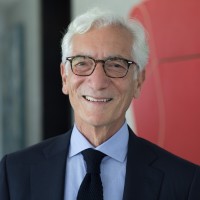
“As an early pioneer in this space, Bridges has always tried to be impactful – not just through what we invest in directly, but also by influencing others through building and evangelizing the idea of impactful investing. ”
— Michele Giddens
What does it look like when billion-dollar funds put impact at the core of their investment strategy?
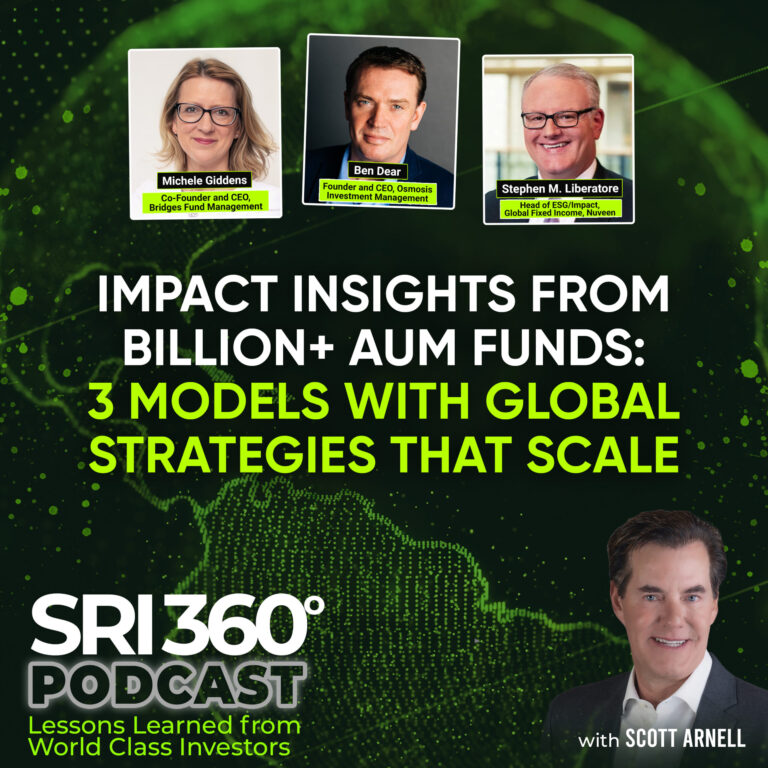
In this 3-in-1 compilation episode, we revisit conversations with investors managing tens of billions across public fixed income, public equities, private equity, and impact-focused real estate. Each one makes the case that environmental and social outcomes aren’t a tradeoff – but a source of lasting value and market-beating returns.
These aren’t side strategies. They’re full-scale, institutional approaches – built from the ground up to align performance with purpose.
Each segment explores a different answer to these core questions:
- What does it mean to center impact in investment decisions?
- What gets prioritized – and what gets left out?
- And how do these investors measure not just where capital flows, but what it actually changes?
Meet the leaders turning billions into measurable impact:
Michele Giddens, Co-Founder and CEO, Bridges Fund Management
Bridges was launched in 2002 with £40 million – including just £10 million in catalytic capital. Today, it manages over £2 billion across private equity, impact real estate, and outcomes contracts.
From the start, its mission has been to invest in solutions that drive both a more inclusive economy and a more sustainable planet – ideally, both at once.
Michele describes their theory of change simply: addressing systemic social and environmental challenges isn’t a tradeoff – it’s a way to unlock high-performing markets. Whether it’s converting inefficient office buildings into low-carbon co-living hubs or financing housing solutions for marginalized youth, Bridges targets overlooked problems with market-driven solutions.
Their now-viral “Spectrum of Capital” helped shape the language of impact investing, offering clarity across a once-fragmented field.
But Michele is focused on what comes next – doubling down on carbon optioneering, embedding impact into every investment, and proving that measurable social and environmental outcomes can go hand-in-hand with competitive, double-digit returns.
Full episode here.
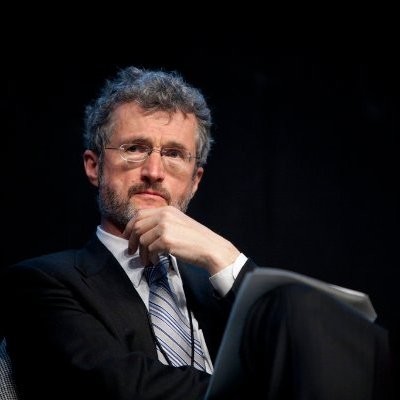
Ben Dear, Founder and CEO, Osmosis Investment Management
Osmosis was built on a simple but overlooked idea: companies that generate more economic value while using less carbon, water, and waste will outperform. Ben believed resource efficiency wasn’t just good for the planet – it could be a consistent, data-driven investment factor.
He was right. Today, Osmosis manages over $17 billion in global public equity strategies, all powered by their own proprietary environmental data. They collect and standardize metrics across carbon, water, and waste – giving them a lens on corporate performance that most investors miss.
Their low-risk flagship targets just 0.5–1% above benchmark returns – yet still outperforms two-thirds of global equity funds on Morningstar. Their higher-alpha strategies deliver 2–3% annually, while cutting portfolio footprints by up to 70%.
This isn’t about feel-good ESG. It’s about measurable environmental impact and financial performance – without the tradeoffs. Osmosis helps institutions reduce risk, hit sustainability targets, and boost returns, all at scale.
Full episodes as follows:
Part 1
Part 2
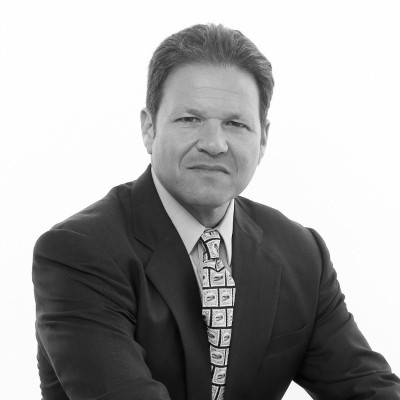
Stephen M. Liberatore, Head of ESG and Impact for Global Fixed Income at Nuveen
Nuveen manages just over $1 trillion globally – and Steve oversees more than $20 billion of that in ESG and impact-focused public fixed income, across 38 distinct funds.
While most associate impact with private markets, Steve has built one of the world’s largest impact bond strategies by focusing on public debt. His theory of change is rooted in scale: in 2023, public fixed income financed over $800 billion in climate transition – ten times more than private equity and venture combined.
Every security in Steve’s portfolios must deliver a direct, measurable environmental or social outcome. That means no sustainability-linked bonds with vague KPIs. Instead, the team targets use-of-proceeds instruments that reduce financing costs for projects like clean energy, affordable housing, and ecosystem restoration – while delivering market-rate returns.
His flagship mutual fund, now nearly $7 billion, has consistently ranked in the top decile of performance over its 15-year track record. And Nuveen’s pure impact funds – its fastest-growing category – prove that transparent structures, deep due diligence, and evidence-based metrics can unlock strong returns while scaling institutional impact.
Full episode here.
Listen to the episode on Apple Podcasts, Spotify, Overcast, Podcast Addict, Pocket Casts, Castbox, YouTube Music, Amazon Music, or on your favorite podcast platform. You can watch the interview on YouTube here.



What was your favorite quote or lesson from this episode? Please let me know in the comments.
SHOW NOTES:
[00:00] Introduction
[04:27] What does Bridges Fund Management actually do?
[07:36] Explaining the Spectrum of Capital framework
[10:22] Why inclusion and sustainability are linked
[13:21] What “just transition” means at Bridges
[19:21] How Bridges screens for property investments
[23:11] Do social investments sacrifice financial returns?
[37:31] Michele’s leadership transition and vision for Bridges
[41:14] Osmosis’ core strategies and structure
[47:49] How product design evolved from conviction to demand
[57:39] Osmosis’ theory of change and the philosophy behind resource efficiency investing
[01:04:56] Ben’s fundraising journey and growth milestones
[01:14:10] Portfolio construction using proprietary ESG data
[01:24:58] Nuveen’s ESG strategy and income fund structure
[01:31:00] Theory of change behind ESG fixed income
[01:36:54] How secondary bond markets reduce capital costs
[01:38:28] ESG risk and long-term credit performance
[01:41:50] 2007 impact framework and how it still guides
[01:56:09] How impact themes were selected at Nuveen
[01:59:45] Where the impact bond market is heading
MORE QUOTES FROM THE INTERVIEWS:
“Sustainability should be straightforward and simple. When viewed through the lens of resource efficiency, it’s objective, transparent, and measurable. It doesn’t require huge complexity in portfolio management or execution. ”
— Ben Dear
“Bloomberg New Energy Finance found that in 2023, public fixed income financed $800 billion in climate transition – 10 times more than private and public equity combined. ”
— Steve Liberatore