“The people in low-income communities aren’t stupid, they’re poor. And they are very much able to be very productive when given the opportunity. ”
— Daniel Izzo
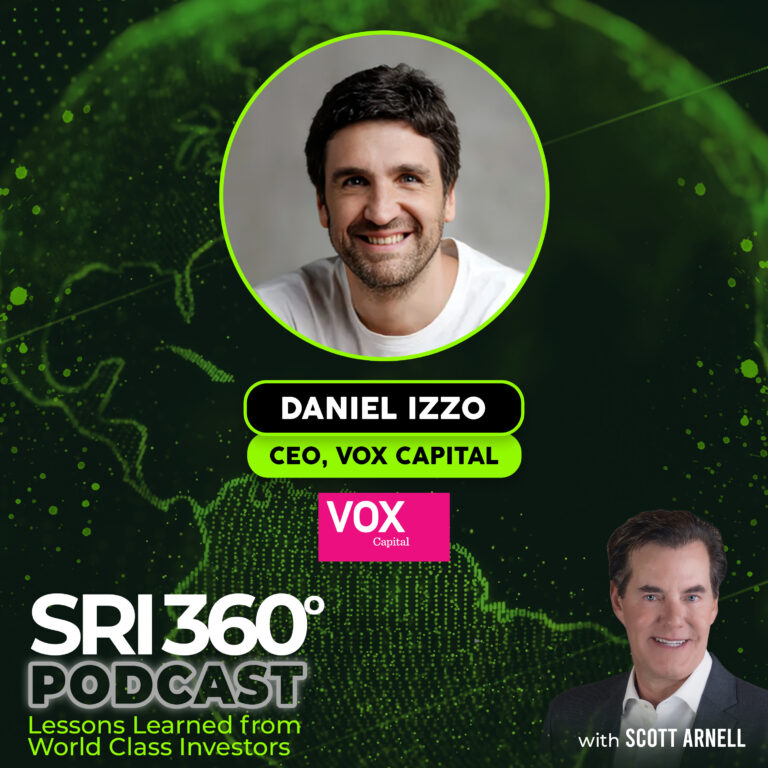
My guest today is Daniel Izzo, co-founder and CEO of Vox Capital – Brazil’s first impact investing firm.
When Vox launched in 2009, the term “impact investing” barely existed in Latin America. There was no roadmap, just a few people who believed business could do more than serve the top of the pyramid.
For Daniel, that belief came from growing up in São Paulo – a city where luxury condos tower above favelas and billionaires live just down the street from families with nothing.
His family of six lived in a two-bedroom apartment. His parents were hard-working and stretched thin. But they were committed to one thing: giving their kids a shot at something better. Education was non-negotiable.
That focus got Daniel into Fundação Getulio Vargas, one of Brazil’s top business schools, where he studied business administration.
His early career was a textbook success – starting in advertising and climbing fast at Johnson & Johnson. But the further he went, the more detached he felt. The work was polished, high-paying, globally respected. But it was disconnected from the country he lived in.
Who was it really helping? He realized he didn’t want to spend his life making the rich a little richer.
That discomfort pushed him to experiment. After his MBA, Daniel negotiated a role in corporate social responsibility at J&J. One of the first things he received was a one-page email from an NGO in Rio, working with women leaders in the favelas. He helped them build a door-to-door health sales program – one that generated income for the women, funded their associations, and expanded J&J’s footprint.
He managed to create a win-win model – business and community rising together.
It was the beginning of a much bigger shift: Daniel left the corporate path and teamed up with Kelly Michel, co-founder of Artemisia, an accelerator for social entrepreneurs. Kelly introduced him to Antonio Ermírio de Moraes Neto, a young investor from one of Brazil’s most prominent business families. Together, the three launched Vox Capital in March 2009.
Daniel didn’t come from a traditional finance background and had never run a fund. What he had was a strong business background, a clear sense of purpose, and a deep familiarity with the problems and the market most investors ignored.
“They’re not stupid, they’re poor. And they are very much able to be very productive when given the opportunity.”
When Vox began in 2009, few understood what they were trying to do – and fewer believed in it. “People thought it was cute… crazy… or got angry at us,” he remembers.
Driven by idealism, they built their first pitch deck with no mention of financial returns – a deliberate statement at the time. But they were wrong. Investors expected performance. So Vox got to work.
For their first three years, they were told not to even try fundraising – just learn, invest, and refine. It turned out to be the best possible path.
The infrastructure wasn’t there. Most investors ignored 85% of the population outside their own social class. Daniel understood why – but he also knew what they were missing.
His team wasn’t avoiding Brazil’s social challenges, but solving them. They focused on early-stage companies that could scale. As he put it, businesses built for scarcity, but still desirable for all.
The breakthrough came from the results. Their second fund proved returns were possible – over 30% IRR – and suddenly, the skepticism began to fade. Today, Vox manages over $300 million across VC, credit, and real estate – all aiming to unlock opportunity for Brazil’s low-income communities.
They invested early in a medical education company that slashed the cost of specialist training from $10,000 to $1,000 and made it available online. That meant more students from smaller cities could stay local, pass their licensing exams, and actually practice in their communities – which led to more specialist doctors in places that never had them before.
They also backed Latin America’s leading ventilator maker, years before COVID hit. When the pandemic overwhelmed Brazil’s hospitals, that company supplied over 80% of the ventilators procured by the Brazilian government during the COVID crisis. Vox helped them scale fast – securing bank credit, opening new factory lines, even finding partners to lend production space.
But Vox isn’t just about writing checks. They take board seats, offer strategic advice, connect founders with new markets, and help navigate major crises.
Today, they’re leaning into catalytic capital, reforestation, regenerative agriculture, and environmental finance – the next frontier for impact.
In Brazil, where deforestation and unsustainable land use drive climate damage, Daniel sees a huge long-term opportunity. Not just to earn returns, but to restore ecosystems. “You don’t just offer returns,” he explained. “You leave a legacy – new forests, healthier soils, sustainable systems.”
When I asked him what he’d fix with a magic wand, he went straight to mindset. “It’ll only be good for everyone, when it’s really good for everyone.” He believes ultra-wealthy families have a responsibility to mobilize their capital – not just as charity, but for collective survival.
Daniel’s story is a reminder that meaningful investing doesn’t start with spreadsheets – it starts with proximity. With actually seeing the gaps that most capital avoids. And then having the guts to build where there’s no playbook.
This is a conversation about what it takes to build in a place like Brazil, where the challenges are complex, the urgency is real, and the opportunity is bigger than most people realize. Daniel makes the case that the next era of capital won’t just be about returns – it’ll be about restoration, resilience, and responsibility.
Tune in.
–
Listen to the episode on Apple Podcasts, Spotify, Overcast, Podcast Addict, Pocket Casts, Castbox, YouTube Music, Amazon Music, or on your favorite podcast platform. You can watch the interview on YouTube here.



What was your favorite quote or lesson from this episode? Please let me know in the comments.
SHOW NOTES:
[00:00] Introduction
[03:47] Growing up with inequality in São Paulo
[07:58] Choosing business school at FGV
[09:35] Career start in marketing at Johnson & Johnson
[14:32] Pursuing an MBA in Montreal
[17:25] Returning to J&J and launching the first social project in favelas
[26:06] Using clown training to build authenticity and resilience
[31:26] Co-founding Vox Capital after personal reckoning
[39:55] Vox Capital – high-level overview
[44:15] Theory of change and 4 strategic ambitions
[49:28] Built for scarcity, desirable for all
[53:19] Vox’s end-to-end investment process
[59:15] Gaining investor trust through BlueMark certification
[01:05:50] Pandemic response and ventilator success story
[01:10:15] Sanar democratizes medical education in Brazil
[01:14:31] Safeguarding mission integrity as companies scale
[01:18:46] The future of impact investing in Latin America
[01:27:22] Rapid-fire questions
Additional Resources:
- Daniel Izzo LinkedIn
- Vox Capital website
- Book: “The Fortune at the Bottom of the Pyramid: Eradicating Poverty Through Profits”
MORE QUOTES FROM THE INTERVIEWS:
“If I had a magic wand, I’d make everyone realize that it will only be good for everyone when it’s really good for everyone. ”
— Daniel Izzo
“Impact without intentionality isn’t real impact – it won’t last. ”
— Daniel Izzo