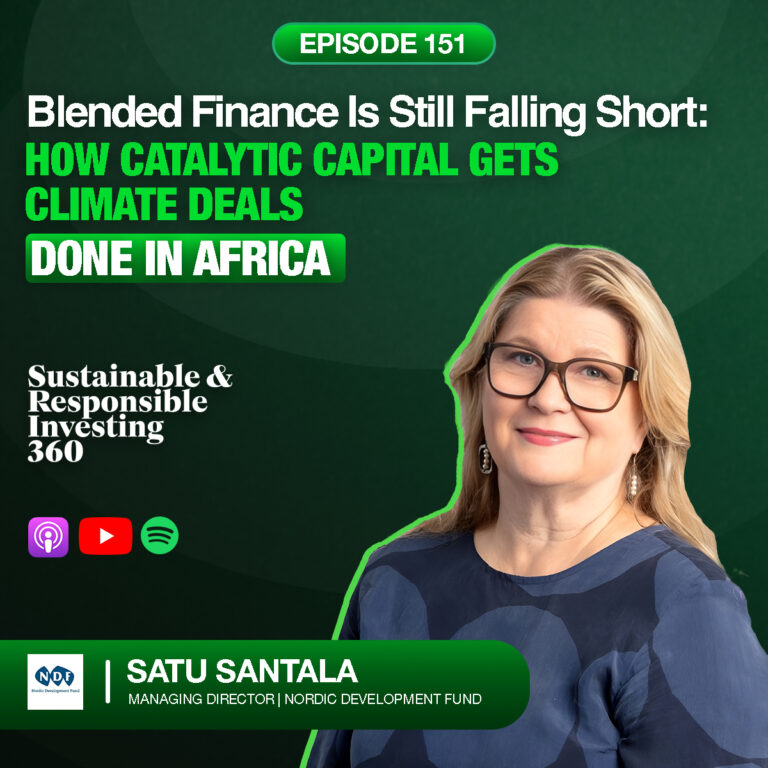
“These pension funds or these institutional investors would invest into good causes because they are good causes. But that’s not the way they operate, and they can’t. ”
— Satu Santala
Blended finance is still falling short, and the fund that takes the first hit says so.
Ask Satu Santala for an uncomfortable truth about blended finance and she doesn’t hedge: so far it has not yet fulfilled the expectations of mobilization. It’s still falling short, and the institutions involved are making it unnecessarily complicated and cumbersome. That’s a striking thing to hear from the Managing Director of the Nordic Development Fund, whose model depends on blended finance working.
NDF is small, 33 people, an active portfolio close to 500 million, an average commitment of about ten to fifteen million, and it can never be the biggest ticket. What it can be is early and junior. In EMCAF, a fund-of-funds for renewable energy, NDF came in with concessional capital in the junior tranche, accepting a lower return and higher risk to de-risk senior investors. The fund is now at 450 million, and about a third of it is that junior tranche. Satu’s understanding is that pension investors simply couldn’t have come in without it: their regulations cap the risk they can take, and there’s no negotiation.
That’s the disconnect she sees between what governments hope for and how institutions actually behave. There’s a wish that pension funds will invest in good causes because they’re good causes. But that’s not the way they operate, and they can’t. Many aren’t interested in anything under 100, 200 million in one go, which is why aggregation, through funds of funds and other big vehicles, matters so much.
Her clearest proof of impact isn’t a fund at all. ARCAFIM, a mechanism built with IFAD and Equity Bank in East Africa, puts ninety million from the bank alongside ninety million from partners so the bank can offer smallholders and rural businesses tenors they’d never otherwise get. The case she makes is simple: a coffee farm that needs several years to start earning can’t be financed with a six-month loan. The facility is new and not yet in operation, but Equity’s leadership told her they expect it to become a profitable business.
She’s equally clear about limits. Not everything in development should be investment, weather stations, she argues, are a public good. And NDF’s own history is a lesson in impermanence: the Nordic ministers had decided to close it before it was reinvented as a climate fund, and half its income today still comes from repayments of decades-old concessional loans. Its capital is secured for another five years or so; after that, the Nordic countries will have to decide again.
The conversation runs from a year with the Finnish Red Cross in Ethiopia at 22, where she learned that development is about the agency of the people you’re working for, through the World Bank board and IFAD, to her return to NDF in March 2024. It ends with a candid account of a fund NDF believed in whose strategy proved too ambitious to attract private finance, and which is now being wound down.
Listen to the full conversation.
Listen to the episode on Apple Podcasts, Spotify, Overcast, Podcast Addict, Pocket Casts, Castbox, YouTube Music, Amazon Music, or on your favorite podcast platform. You can watch the interview on YouTube here.
–


What was your favorite quote or lesson from this episode? Please let me know in the comments.
SHOW NOTES
[00:00] Intro
[03:00] “Make me sound as smart as the others”
[03:24] The Nordic fund the ministers had decided to close
[07:12] Half its income still comes from decades-old loans
[08:23] A lawyer’s daughter from rural Finland
[12:51] Twenty-two, and a year with the Red Cross in Ethiopia
[14:52] Children dying of diarrhea, and the lesson about agency
[17:30] Herding well-funded cats in Tanzania
[20:02] Eight countries, one World Bank board seat
[22:27] Who captures the value of a crisis that never happens?
[23:54] Back to NDF, now responsible for spending it
[25:34] What NDF actually does, with 33 people
[28:45] Why Sub-Saharan Africa, and what a small fund can do
[30:56] EMCAF: the junior tranche pensions needed
[33:15] Junior at 2%, why would anyone sign up?
[33:56] Backing a first-time fund manager
[35:52] What a pension fund needs before it commits
[37:19] Good causes vs. mandates: the biggest disconnect
[39:46] Is Africa’s risk overpriced?
[40:46] Did NDF’s money change the deal, or just subsidize it?
[43:11] “Adaptation is gritty, mitigation is sexy”
[45:20] Kigali’s restored wetlands
[46:33] When a project should stop chasing private money
[48:06] A coffee farm on a six-month loan: ARCAFIM
[50:29] Make ‘Nordic climate leadership’ concrete
[52:37] Why fund a person, not a policy
[54:58] Five more years of capital, then what?
[55:56] How to get NDF into your fund
[58:44] After the Nordic Climate Dialogues
[01:00:40] A lasting market, or a series of deals?
[01:01:37] The biggest misconception about climate investing
[01:02:33] The uncomfortable truth about blended finance
[01:03:30] Rapid fire: the fund that was wound down
GUEST LINKS
LISTEN NEXT
Episode 85 — How Private Equity Converted £10M of Catalytic Capital Into £2B With Double-Digit Returns. Satu explains catalytic capital from the side that provides it. Michele Giddens, co-founder of Bridges Fund Management, tells it from the side that received it: £10 million of UK government money that went in first and came out last in Bridges’ first fund, and the £2 billion the firm has raised since.