“You wanna look at situations where the drivers of impact are completely aligned with the drivers of business and financial success. If not, our capital should not be the one applied to that company. ”
— Maya Chorengel
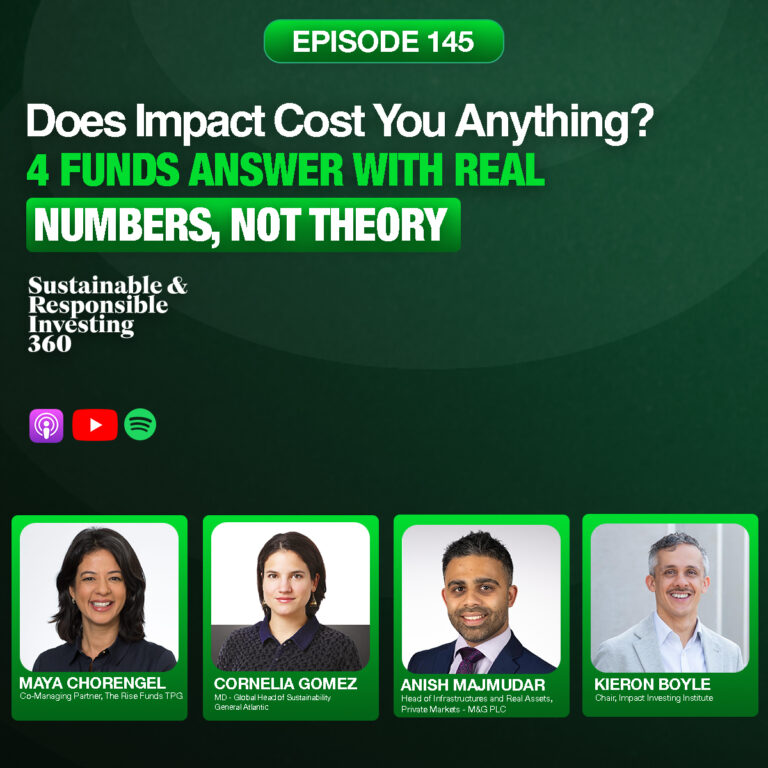
In this compilation episode, I revisit four conversations from the SRI360 archive that all circle the same hard question: does impact actually pay, and how do you prove it? Four investors answer from four very different seats — growth equity, private equity sustainability, infrastructure, and the policy world trying to move mainstream capital — and none of them accepts the idea that impact means giving up returns.
Here are the guests featured in the episode:
Maya Chorengel – The Rise Fund: collinear investing
Maya Chorengel, Co-Managing Partner of TPG’s Rise Fund, built the fund’s thesis on a single word: collinearity. Rise only invests where the drivers of impact and the drivers of financial return move together, with no trade-off between the two — if amplifying impact would hurt the business, or maximizing profit would erode the impact, the fund says its capital is the wrong capital. It backs growth-stage companies, generally north of $20 million in revenue with proven unit economics, and every deal has to clear two underwriting tests at once: a 20%-plus gross IRR and a measurable, net-positive impact floor. The impact side isn’t a vibe — TPG built a formal methodology, expressed as an equation and run by an in-house team, that scores volume, depth, and additionality before a deal is done and tracks it through to exit. Her example is Dreambox, an adaptive-learning company started by a Microsoft engineer for his own child, which found that bringing personalised maths learning into schools could deliver much wider impact — a case study in growth and impact pulling in the same direction.
Listen to the full episode here
YouTube episode here
Cornelia Gomez — General Atlantic: three levers of value
Cornelia Gomez, Global Head of Sustainability at General Atlantic, is impatient with the search for a grand correlation between ESG and returns — she calls linking sustainability to value “a bit of the holy grail,” a weak-correlation game. Instead she decomposes it into three concrete levers. The first is top-line revenue: helping a consumer brand launch a sustainable product line customers will pay a premium for. The second is cost reduction and value protection — energy efficiency, but also “the cost of not having a problem,” like using portfolio-wide data to fix an employee-turnover rate a company had simply accepted. The third is exit: a two-year playbook to get a company IPO-ready so that sustainability is never the question that stalls a roadshow. Her real discipline is speed and honesty — given a company’s sector, geography, and model, she can name its three “hot potatoes” in ten minutes, and she’s blunt that a fragmented supply chain makes most climate commitments unmeasurable and, if overstated, straight greenwashing.
Listen to the full episode here
YouTube episode here
Anish Majmudar — M&G: real assets, where it lines up
Anish Majmudar, Head of Real Assets at M&G, runs an impact strategy built on the argument that real assets are where impact and cash flow align most naturally. The fund has committed roughly $750 million across more than 100 portfolio companies and projects, targets a double-digit return, and blends long-term yield with growth. He organizes it around three themes — the energy transition, responsible consumption and production, and social and economic inclusion — chosen to build a diversified portfolio rather than a single bet. A renewable energy project, he points out, is the rare case where the thing you build is the impact and the cash flow at once. He’s also candid about how the opportunity revealed itself: watching the reinsurance market struggle to price a changing climate using backward-looking data, and realizing that investing for the future has to be forward-looking or it isn’t investing at all.
Listen to the full episode here
YouTube episode here
Kieron Boyle — Impact Investing Institute: moving the trillions
Kieron Boyle, CEO of the Impact Investing Institute — a nonprofit set up by the UK government — works the opposite end of the problem from the other three. Rather than run a fund, the Institute acts as a bridge between mainstream capital markets and the impact field, connecting the world’s largest asset owners and allocators with government, foundations, and civil society. His theory of change runs on three verbs: embed proven practice so it lasts, extend it to adjacent pools like the roughly $10 trillion held in family offices, and experiment where the field doesn’t yet have answers. The stated ambition for the Institute’s next five years is to help bring an additional £1 trillion of impact capital into the space. He’s frank that the whole idea is still contested, especially amid the ESG backlash, but argues the core premise — that every investment has an impact, positive or negative — is too simple and too true to lose.
Listen to the full episode here
YouTube episode here
Four seats, four methods, one throughline: none of them treats impact as charity, and all four are trying to prove, in different ledgers, that doing it well is how you win. Links to all four full episodes are in the resources below.
–
Listen to the episode on Apple Podcasts, Spotify, Overcast, Podcast Addict, Pocket Casts, Castbox, YouTube Music, Amazon Music, or on your favorite podcast platform. You can watch the interview on YouTube here.



What was your favorite quote or lesson from this episode? Please let me know in the comments.
SHOW NOTES:
[00:00] Intro
[03:09] Maya Chorengel (The Rise Fund): the theory of change
[07:44] Collinear companies, and where TPG’s capital fits
[10:48] Underwriting impact with an equation
[13:15] Growth investor, not venture risk
[17:15] Dreambox: adaptive learning that scaled
[22:39] Cornelia Gomez (General Atlantic): three value-creation levers
[23:04] Lever 1 — top-line revenue and the sustainability premium
[24:20] Lever 2 — cost, and “the cost of not having a problem”
[26:42] Lever 3 — the two-year path to an IPO-ready exit
[28:27] Why the grand ESG correlation studies don’t hold up
[30:21] The ten-minute diagnostic: three hot potatoes
[35:00] Anish Majmudar (M&G): a real-assets impact fund
[39:27] Pricing climate risk the reinsurers missed
[41:32] Why real assets align impact and cash flow
[45:14] The three themes: energy, consumption, inclusion
[49:10] Kieron Boyle (Impact Investing Institute): moving the trillions
[50:24] What the Institute is
[54:03] Theory of change: embed, extend, experiment
[01:00:12] Measuring the Institute, and the ESG backlash
[01:02:57] Closing: the successful businesses of the century