“Investing in the circular economy, at least today, is a way of actually de-risking your investment — investing in the direction of where major industry is going. ”
— Ron Gonen
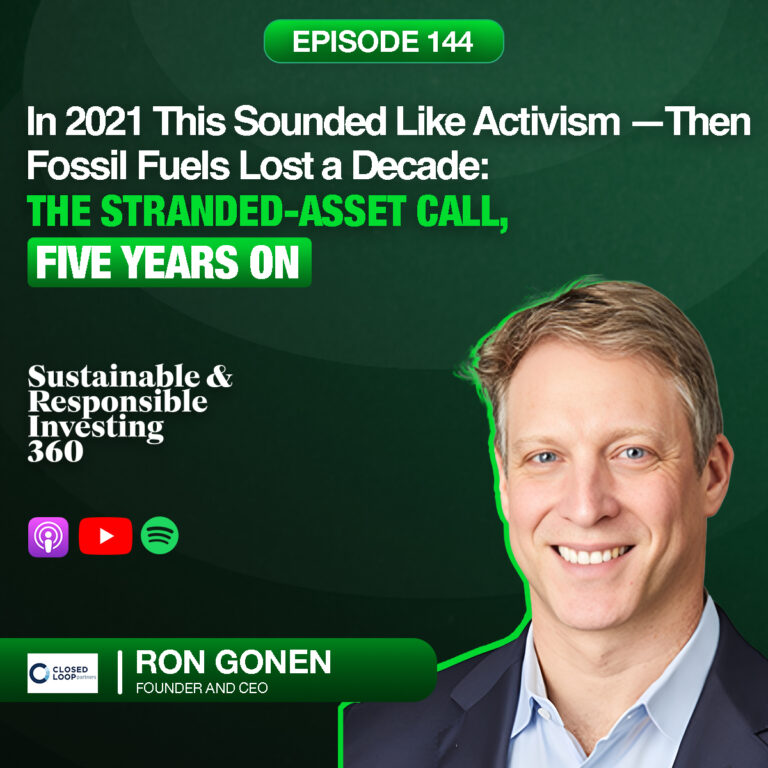
This episode is a re-release with a purpose. In the autumn of 2021, I recorded this conversation with Ron Gonen, Founder and CEO of Closed Loop Partners, while writing the book this podcast grew out of. His central claim sounded like activism: fossil fuel assets were already stranded, the smart money had left, and investors divesting in 2021 were a decade too late. He said it in the middle of the best year energy stocks had had in a decade — and the year after was better still. For eighteen months, the call looked wrong.
It didn’t stay that way, which is why I’m bringing it back. By 2024 the S&P 500’s fossil fuel components returned 5.7% against 25% for the index; the sector has underperformed in seven of the last ten years and shrunk from 30% of the index in 1980 to roughly 3% today. The regulation he predicted arrived: two states had packaging producer-responsibility laws when we spoke, and seven do now, with Oregon’s fully operational. And the single national recycling company he said America needed — which didn’t exist at the time — he built a year later: Circular Services, now the largest privately held recycler in the US, with close to a billion dollars behind it from Brookfield and corporate investors including Microsoft, Nestlé, PepsiCo, SK Group, Starbucks and Unilever.
The interview traces how he got here. Ron started at Andersen Consulting, then co-founded RecycleBank during his MBA — rewarding households for recycling — and ran it from 2003 to 2010, twice earning it the title of the world’s number-one venture-backed clean tech company. He clashed with backers who wanted a faster IPO, then ran recycling, organics, and electronics as New York City’s deputy sanitation commissioner, and was named Earth Day New York’s Public Official of the Year in 2013. He credits an early George Soros essay with convincing him that aligning business with sustainability could make money, not just headlines.
Closed Loop Partners is how he put that conviction to work: an investment firm and innovation center that deploys capital anywhere along a solution’s growth curve — venture, growth equity, private equity, and project finance — across packaging, food and agriculture, fashion, and electronics. The funds target net IRRs of roughly 15–20%, and this is not concessionary capital. He argues the linear economy only dominates because it is subsidised — the fossil fuel industry that makes plastics collects around $20 billion a year — and that a fund screening for stakeholder-aligned companies naturally avoids the Enrons and stranded fossil stocks while catching the Unilevers.
On process, he is a value investor first: every fund runs a strict price-to-value discipline, and on the venture side the hard screen is a sub-$10 million post-money valuation, then whether the technology can become a real business, then the team. His examples — HomeBiogas, a household anaerobic digester now public in Tel Aviv, and Mori, an MIT-born edible silk coating that extends shelf life — show the pattern: using technology and material science to reduce waste, extraction and landfill in the supply chain. His corporate LPs, including major consumer goods companies, give him a proprietary read on where supply chains are heading, which he argues de-risks the thesis rather than romanticises it.
His biggest structural idea is also his most contested: redirect $100 billion over five years from fossil fuel subsidies into circular and renewable industries. As reallocation, not new spending, he argues it would cost taxpayers nothing while resetting a tilted market. That is the part that hasn’t happened — federal policy moved the other way, and the resistance he once compared to a bug bite is now a 17-state lawsuit against California’s packaging law. He was right on the assets, the regulation, and the infrastructure. The open question, and the live risk in the whole thesis, is the politics — the one variable no investor controls.
–
Listen to the episode on Apple Podcasts, Spotify, Overcast, Podcast Addict, Pocket Casts, Castbox, YouTube Music, Amazon Music, or on your favorite podcast platform. You can watch the interview on YouTube here.



What was your favorite quote or lesson from this episode? Please let me know in the comments.
SHOW NOTES:
[00:53] Introduction
[01:19] The rewind: does his 2021 call hold up?
[02:39] The scorecard: energy, regulation, recycling
[04:03] Where the thesis hit trouble
[04:54] Support the show
[05:26] Ron’s start: RecycleBank and the VC clash
[07:21] Earth Day honor and founding Closed Loop
[08:16] The George Soros turning point
[09:52] What Closed Loop Partners is
[10:28] Fund structure, AUM and return targets
[11:47] Linear vs. circular economy
[12:37] Why circular funds still beat the market
[13:44] Green vs. greed: the two-fund test
[16:19] A message to CIOs exiting fossil fuels
[17:22] The four sectors they focus on
[17:52] Investment strategy: value investing
[19:02] Non-financial screens and the pipeline
[20:05] The venture screen
[21:33] Portfolio: HomeBiogas and Mori
[23:04] Measuring impact
[25:21] Greenwashing and gaming the metrics
[26:31] Who invests in Closed Loop, and why
[29:13] Why circular investing de-risks
[29:35] The Center for the Circular Economy
[31:54] America’s broken recycling, and the fix
[32:57] Subsidies, externalities and “the great scam”
[35:21] Up against the incumbents
[36:46] The book: The Waste-Free World
[37:54] The Reuse contest