“The risk perception is most misplaced. The resilience is least understood. The aspiration is definitely not understood. ”
— Jyotsna Krishnan
What does it take to get deal-level impact data into the open, loss rates, exits, the defaults that didn’t happen, in an industry that has built its credibility on frameworks and AUM figures but rarely discusses what actually came back?
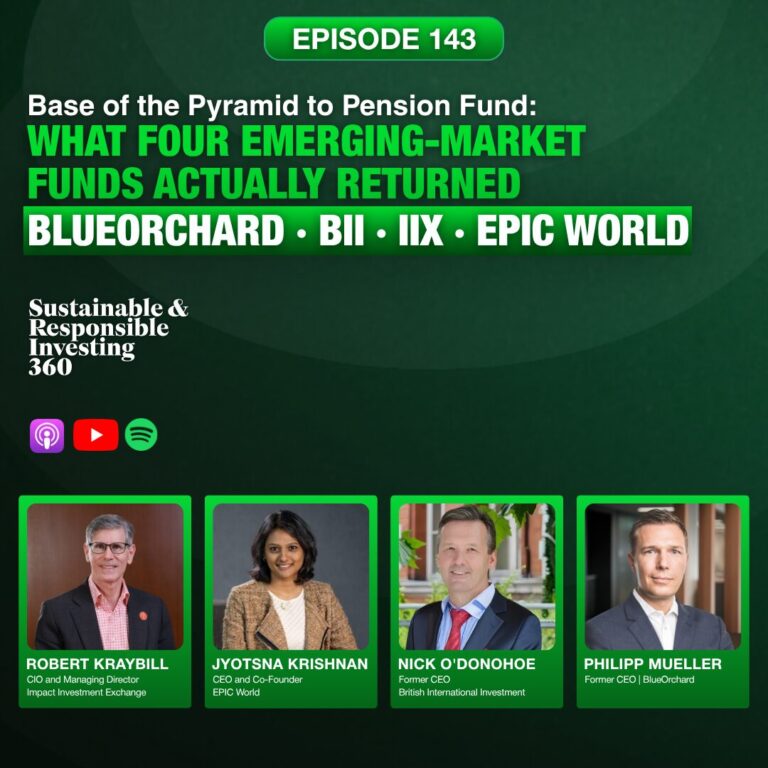
In this compilation episode, Scott revisits four conversations with practitioners who put real capital into markets most institutional investors walk straight past, and who are willing to say, on record, what the numbers showed.
The four guests represent four distinct approaches to the same underlying challenge: how do you move capital from institutions with fiduciary mandates into markets with weak credit infrastructure, currency risk, fragmented data, and borrowers who have never interacted with the formal financial system and still make it work?
Here are the guests featured in the episode:
Philipp Mueller, who at the time of recording was CEO of BlueOrchard, runs the world’s largest microfinance fund – $2.4 billion deployed through a network of vetted local intermediary institutions across emerging and frontier markets, with a single-intermediary model that keeps the capital chain short and the accountability clear. He explains how the institution was founded out of the UN’s Millennium Development Goals working group, why he avoids institutions with government links, and what a leather craftsman in Piura, Peru with a $200 first loan and a shop in a tourist market looks like two decades on.
Listen to the full episode here
YouTube episode here
Nick O’Donohoe spent seven years as CEO of British International Investment, the UK’s oldest development finance institution and inherited an organisation whose 2% return target he turned into a 5% actual return across a period when almost every African country in BII’s portfolio went through major macroeconomic or political turmoil. He explains the structure of BII’s portfolio, why patient capital means something different at a DFI than at a private equity fund, and what the PSI Impact Score Methodology was designed to solve, the problem of investment teams spending months developing transactions with no idea how an investment committee would evaluate the impact case.
Listen to the full episode here
YouTube episode here
Robert Kraybill, CIO and Managing Director at Impact Investment Exchange, built the Women’s Livelihood Bond from an $8.5 million first issuance to a $100 million sixth bond sold almost exclusively to pension funds, all listed on the Singapore Exchange. He explains the blended structure (90% senior bonds, 10% subordinated first-loss notes from foundations and development organisations, plus a partial guarantee from USAID and latterly Sida), how the Orange Bond Principles were modelled on the green bond market to encourage other issuers to enter the gender lens investing space, and why listing on a stock exchange is both an idealistic and a pragmatic choice.
Listen to the full episode here
YouTube episode here
Jyotsna Krishnan, CEO and Co-Founder of EPIC World, has spent her career mapping the entrepreneurial households that make up approximately 70% of India’s population, a segment she calls the unseen middle, systematically underserved by businesses that parachute in with lighter-weight versions of urban products rather than building from the ground up for a customer that is more resilient, more aspirational, and better understood than global allocators assume. She describes how COVID revealed the structural resilience of the multi-income household, why distribution investment (not product design) is the primary constraint, and what women-led farmer producer companies in Damoh, Madhya Pradesh tell you about the pace of change on the ground.
Listen to the full episode here
YouTube episode here
What connects all four: a shared argument that the risk in these markets is systematically mispriced relative to the actual performance data and that the instrument design problem is closer to being solved than the mainstream capital allocation conversation suggests.
If you work in institutional capital allocation, blended finance, or emerging market investing or if you want to understand what the deal-level evidence actually shows after twenty years of impact investing, this is an episode you won’t want to miss.
–
Listen to the episode on Apple Podcasts, Spotify, Overcast, Podcast Addict, Pocket Casts, Castbox, YouTube Music, Amazon Music, or on your favorite podcast platform. You can watch the interview on YouTube here.



What was your favorite quote or lesson from this episode? Please let me know in the comments.
SHOW NOTES:
[00:00] Impact Investing’s Disclosure Problem
[02:20] Philipp Mueller, Blue Orchard: The World’s Largest Microfinance Fund
[02:29] What Microfinance Is — and Why It Isn’t a Donation
[04:24] Ticket Sizes, Markets & How Loan Sizes Vary by Geography
[07:17] Getting Capital from Investor to Base-of-the-Pyramid Borrower
[08:08] Single-Intermediary Model: Due Diligence, Credit Rating & Impact Assessment
[11:06] One Layer Only — and Why That Preserves Accountability
[11:43] Corruption, Rule of Law & Why Blue Orchard Avoids Government-Linked Institutions
[13:42] Real-World Impact: The Leather Craftsman in Piura, Peru
[16:59] Nick O’Donohoe, BII: Patient & Flexible Capital — What Those Words Mean at a DFI
[18:33] The 2% Return Target & the False Dichotomy on Market-Rate Returns
[21:06] How a 2% Target Became a 5% Actual Return
[23:00] Portfolio Construction: Catalyst & Growth, Balancing Impact with Return
[25:00] The Catalyst Portfolio: Designed for Investments Beyond Normal Risk Tolerance
[26:08] The PSI Impact Score: A Framework Investment Officers & Committees Could Both Trust
[29:32] Robert Kraybill, IIX: Empowering Women at the Intersection of Gender & Climate
[30:14] IIX’s Theory of Change: Promoting Impact Investing as a Market, Not a Product
[30:56] The Women’s Livelihood Bond: Genesis, Structure & $228 Million Raised
[38:31] First Loss, Senior Bonds & the Blended Finance Structure Explained
[39:37] Listed on the Singapore Exchange: Idealistic & Practical Reasons
[41:51] Jyotsna Krishnan, EPIC World: The Entrepreneurial Household as an Economic Unit
[43:45] The Biggest Misconception: Why This Market Isn’t Risky
[45:22] 70% of India’s Population & What the Unseen Middle Actually Means
[45:51] Why Businesses Built for Discretionary Spends Fail the Non-Discretionary 90%
[50:48] Field Visit to Damoh: Women-Led Farmer Producer Companies & Generational Change