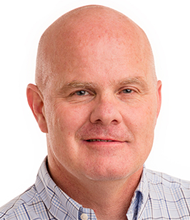
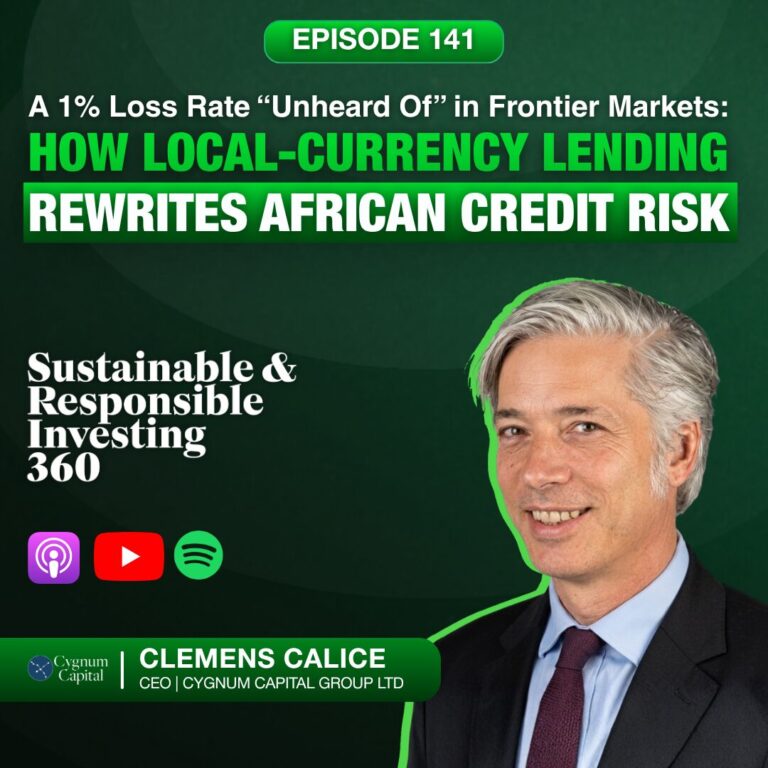
“Clearly, if a business is not viable because you force it to be green, then that kind of defeats the purpose. ”
— Clemens Calice
What does it take to walk out of Goldman Sachs in the middle of a global financial crisis and build a climate finance platform in markets that most institutional investors have never looked at – with no business plan, no business model, and 200 chickens in your Nairobi garden as your most formative lesson in frontier market dynamics?
Today’s guest is Clemens Calice, CEO of Cygnum Capital Group, an independent asset manager with $1.5 billion under management across seven funds and around 150 to 160 individual investments spanning renewable energy, local-currency bonds, agriculture, energy efficiency, and early-stage venture.
Listen in as Clemens traces a career that begins at ETH Zurich – one of Europe’s most rigorous technical universities – passes through Morgan Stanley in London and Singapore during the Asian financial crisis, and lands at Goldman Sachs structuring billion-dollar energy deals, before he walks out in 2009 to co-found what eventually becomes Cygnum Capital Group. Along the way: a seed-potato business in Tanzania that, in his own words, “wasn’t particularly successful” financially but taught him more about frontier-market realities than anything before it; a local-currency bond fund that defied every expectation the market had about African credit risk; and a structured energy-efficiency vehicle – the Africa Go Green Fund – built in a segment traditional development finance had largely overlooked.
You’ll hear the case for why the real barrier to institutional capital in Africa is not risk-return – it’s deal size, compliance burden, KYC cost across 54 fragmented jurisdictions, and the simple fact that no individual portfolio manager takes on nine months of work for a $10 million ticket. Clemens walks through how Cygnum’s African Local Currency Bond Fund, anchored by KfW and co-invested alongside domestic pension funds and insurers, achieved a cumulative loss rate of around 1% over 11 years across markets rated as extremely weak from a credit perspective – and what that tells you about systemic resilience once you eliminate dollar mismatch and bring in local institutional discipline.
From the blended-finance capital stack in plain terms – 20% first-loss junior equity, 20% senior equity, 60% commercial leverage – to the Copperbelt Energy bond going from 178% oversubscribed on its first tranche to 238% on the second, to why Clemens rejects the term “impact investor” in favour of “responsible investor” and what he means by “honest impact investing,” this conversation is a ground-level view of how frontier-market climate finance actually gets built.
What is the single biggest obstacle standing between here and a continent whose energy infrastructure matches its share of the world’s population? And what does 200 chickens in a Nairobi garden have to do with any of it?
Clemens answers these questions and many more.
If you work in frontier market investing, blended finance structuring, or climate finance in emerging markets – or if you simply want to understand why good deals alone do not create good markets – this is an episode you won’t want to miss.
Listen to the full conversation.
–
Listen to the episode on Apple Podcasts, Spotify, Overcast, Podcast Addict, Pocket Casts, Castbox, YouTube Music, Amazon Music, or on your favorite podcast platform. You can watch the interview on YouTube here.



What was your favorite quote or lesson from this episode? Please let me know in the comments.
SHOW NOTES:
[00:00] Leaving Goldman in 2009: Starting a Firm with No Business Plan
[02:56] Lion’s Head: Origins, Name & the South African Connection
[06:23] Emerging Markets as the Only Skill & the Tanzania Farm Detour
[10:54] 200 Chickens in Nairobi: Understanding the Smallholder Farmer
[16:03] Growing Up in Vienna, ETH Zurich & Into Banking by Accident
[19:12] Asian Crisis, INSEAD, New York & Goldman Sachs
[22:03] Cygnum Today: $1.5B AUM, Seven Funds & Four Continents
[24:23] Asset Management & Investment Banking: How the Two Sides Feed Each Other
[25:45] Investor Base & Crowding In Private Capital
[28:09] Rejecting “Theory of Change” for “Responsible Investor”
[31:13] The African Local Currency Bond Fund & KfW Partnership
[29:07] Why Local Currency: Eliminating Systemic Risk & a 1% Loss Rate Over 11 Years
[42:58] Blended Finance Demystified: The 20/20/60 Capital Stack
[48:42] African Risk Premiums & Why Private Capital Hasn’t Arbitraged the Gap
[52:36] Cygnum as Intermediary: Removing Non-Financial Barriers to Scale
[54:16] Africa Go Green Fund: Energy Efficiency as the Underfunded Opportunity
[57:24] Clean Cooking, E-Mobility & Green Buildings: What’s Scaling & What’s Not
[01:00:19] Going First: Telecom Towers, CrossBoundary Energy & the Copperbelt Bond
[01:05:51] African Infrastructure Risk: Perception vs. Data Reality
[01:07:52] Honest Impact Investing & the “Responsible Investor” Label
[01:11:12] Gas, Baseload & the Case for African Economic Sovereignty
[01:16:05] The Lion’s Head Split & the Rebrand to Cygnum
[01:18:56] Platform Growth: 20–25% Annually & What Has to Change
[01:21:28] Rapid Fire Questions
Additional Resources:
MORE QUOTES FROM THE INTERVIEW:
“It’s a focus on creating businesses that are sustainable — that have a financial model that allows them to grow and continue — and sticking with them to support them in periods of stress. ”
— Clemens Calice
“Nowhere does it say that in order to save our planet we have to be 100% carbon neutral. It’s surely better to be 80% carbon neutral than to kill your economy. ”
— Clemens Calice