“We should think about generations, not…. quarters. ”
— Matilda Ho
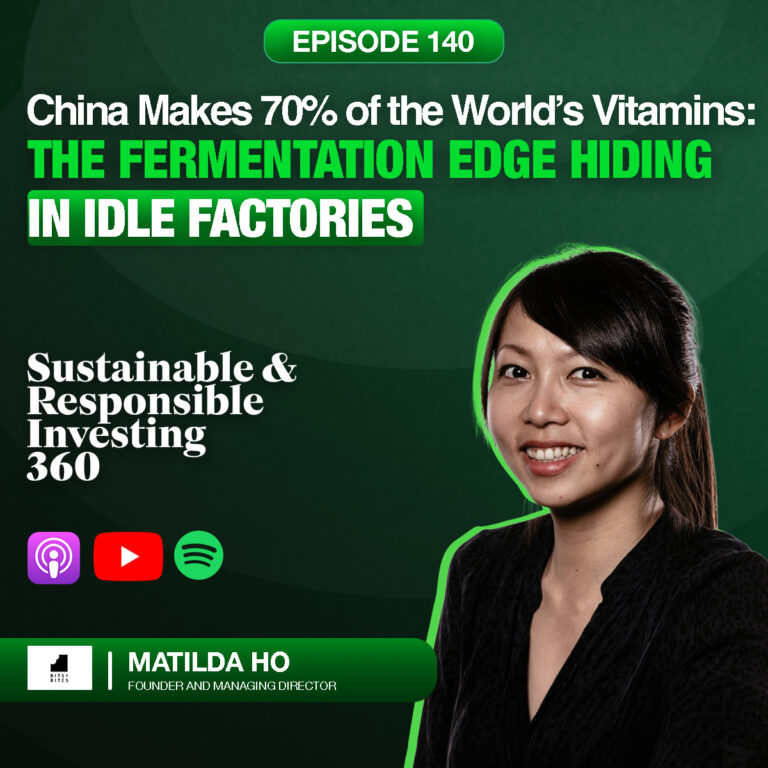
In this episode, I speak with Matilda Ho, Founder and Managing Director of Bits x Bites, about why the real work in food happens upstream rather than at the checkout, what makes China the highest-leverage place on earth to fix a food system, and the path from a Taiwanese childhood with no kitchen access to running China’s first food tech venture fund.
Matilda grew up in Taiwan under what she calls a fairly extreme version of tiger parenting — studying alone, no friends, meals eaten in fifteen minutes of silence. Her mother’s line was that the one job you never want is chef, because cooking is what you do when you fail at school. She was not allowed in the kitchen for 25 years.
Her grandmother had given her a magic box when she was six. At nineteen she opened it properly, taught herself every trick from the English instructions, and became Taiwan’s first female dove magician — despite being frightened of birds. One minute on stage cost her six hours in front of a mirror. She credits magic for two things she uses now: seeing what others miss, and storytelling, which she calls a core skill for a fund manager.
After Unilever, she went to the University of Chicago Booth School of Business, then spent five years consulting at BCG and IDEO, almost entirely on food and agriculture. One project changed her direction. She was asked to assess how likely a large Chinese meat processor was to have another food safety scandal, and found the country was averaging roughly half a million food safety incidents a year — including hair dye and colour turning up in soy sauce. Halfway through, horsemeat was detected in a hamburger packaged food in Tesco, UK, the client decided the risk was unquantifiable, and the deal died.
So she founded Yimishiji, an online farmers market built around traceability. It worked, but not the way she wanted. People only changed their habits after a life event — a baby, a diagnosis. A movement, she concluded, but not a business model. The deeper problem was structural: a vegetable can pass through seven pairs of hands before it reaches a table, and two thirds of it is lost on the way.
In 2016 she founded Bits x Bites to work further upstream. She raised about $10 million from the same corporate backers, ran a food tech accelerator for twelve months, and concluded it did not fit — agrifood is too many different sectors to run founders through one program. The model became a concentrated VC fund instead, vintaged in October 2020 at $100 million and backed by sovereign funds from Singapore, the Middle East and China, agrifood strategics and family offices. Fifteen companies since, half domestic and half global, all with a mandate to scale in China. A team of seven, 500 to 600 founder conversations a year, two partners with a veto each, and a board seat now a condition of investing.
Much of our conversation is about why China. The arithmetic is stark — around 20% of the world’s population, under 7% of the arable land, 1.4 billion people to feed, and more than 85% of soybeans imported. But the opportunity she keeps returning to is biomanufacturing. Where European biotech founders struggle to fund scale-up, China has the opposite problem: overcapacity, brownfield sites, idle fermentation tanks and the plant managers who know how to run them. Seventy percent of the world’s vitamins, two-thirds of its amino acids and more than 80% of its stevia already come from there.
She is unsentimental about what does not work. Beyond Burger’s peas are grown in Canada, processed in Suzhou and formulated in California, and the margin never survives the journey. China, she points out, already has tofu — clean, plant-based, cheap and two thousand years old. She would rather fund certainty than novelty: functional ingredients, animal health, and matcha, half of which is now grown and processed in China and shipped to coffee chains in the US and Europe.
We also get into China’s “visible hand” — local governments running fund-of-fund structures and backing specialized managers, until government money became the largest source of innovation capital in the country. Her first exit, in year five, was a stake in a precision fermentation dairy business sold to a provincial government vehicle. Where most domestic funds have a five-year life, she argues, DPI matters far more than IRR.
What stayed with me is the patience underneath all of it. She thinks in generations rather than quarters, and describes mindful patience as knowing how to act while you wait. In an industry in a hurry, she is a magician who learned that the trick only works if you stand in front of the mirror for six hours first.
Listen to the full conversation.
–
Listen to the episode on Apple Podcasts, Spotify, Overcast, Podcast Addict, Pocket Casts, Castbox, YouTube Music, Amazon Music, or on your favorite podcast platform. You can watch the interview on YouTube here.



What was your favorite quote or lesson from this episode? Please let me know in the comments.
SHOW NOTES:
[03:17] Banned from the kitchen for 25 years
[05:12] What a tiger mother actually means
[07:01] The magic box, and Taiwan’s first female dove magician
[09:20] Six hours in the mirror for one minute on stage
[09:55] Unilever, and the road to Chicago Booth
[10:29] Choosing Shanghai
[11:17] The project that changed everything
[12:17] Half a million food safety incidents a year
[13:47] Horsemeat in Tesco burgers kills the deal
[14:20] Turning 30 and questioning the work
[16:24] What she couldn’t unsee: a third rots on the farm
[18:06] Why fixing it one shopper at a time doesn’t scale
[20:47] Founding Bits x Bites
[22:15] Bits x Bites today: the $100M fund
[24:26] First closing, AUM, and why the accelerator failed
[26:54] The mission, and the three Ps
[29:16] 20% of the population, under 7% of the land
[32:00] The verticals, the stage, the check size
[35:52] Cost is king and taste is king
[39:31] What novel protein still has to prove
[41:56] Biomanufacturing: China’s quiet structural edge
[43:34] Bio-made ingredients replacing chemical ones
[45:40] “The next China is China”
[48:53] China’s visible hand
[52:00] The first exit, and why DPI beats IRR
[54:59] Hiring badly, and how it changed founder diligence
[58:39] When doing the right thing costs you
[01:03:45] Inside the decision-making process
[01:05:48] Fewer names, bigger checks, board seats
[01:05:48] Measuring impact without the vocabulary
[01:07:10] Who captures the upside? What drones changed for smallholders
[01:11:23] Why pure SaaS never works in agriculture
[01:14:33] One meal a day
[01:16:21] The GLP-1 question
[01:18:46] The next ten years
[01:20:28] Mindful patience, and the matcha story
[01:24:29] The restaurant dream
[01:26:23] Finish the sentence: what the West gets wrong
[01:28:48] Rapid Fire Questions
Additional Resources:
- Matilda Ho on LinkedIn
- Bits x Bites website
- Matilda Ho’s TED profile
MORE QUOTES FROM THE INTERVIEW:
“It’s like finding your husband… once you sign… you’re with this person for 10, 20 years — until you exit this business. ”
— Matilda Ho
“We chose to take a longer term view. It’s fine to sacrifice some short-term profit for the sake of healthy longevity. ”
— Matilda Ho