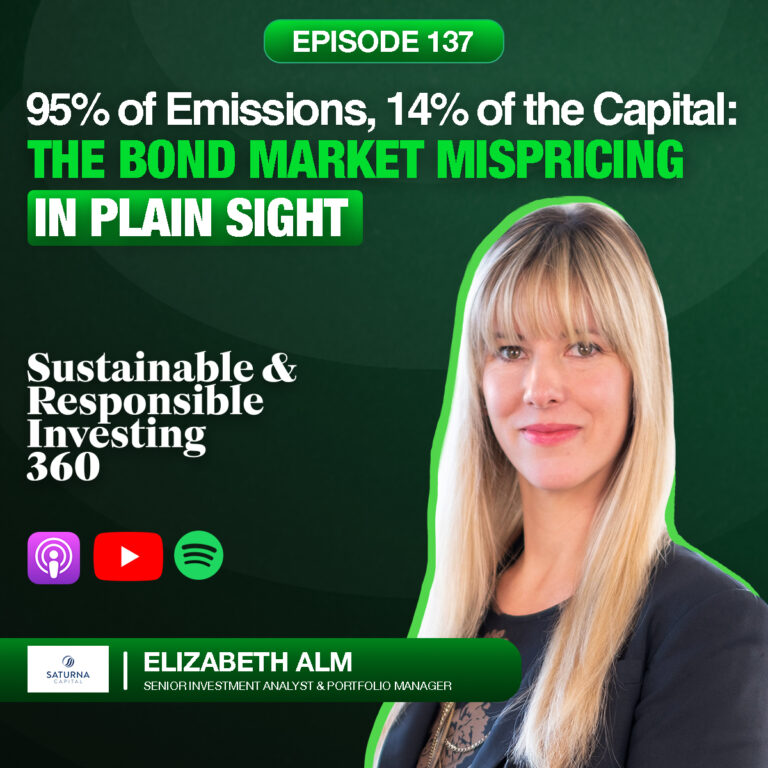
“The rating agencies didn’t catch it. The market didn’t catch it. The true risk was not priced in. The pattern can break. ”
— Elizabeth Alm
In this episode, I speak with Elizabeth Alm, Senior Investment Analyst and Portfolio Manager at Saturna Capital, about why a bond’s label does not always match its real impact, how Islamic bonds (sukuk) work, and the unusual path — from an archaeology dig in Egypt to a Wall Street trading desk — that led her to become a sustainable bond investor.
Elizabeth grew up in rural Connecticut, in a town of about 4,000 people, on five acres of land. Her mother is a classical flutist who played in the Hartford Symphony, and her father worked in finance as a negotiator in the aircraft industry. She learned math by balancing a checking account, opened her first brokerage account at age ten, and even paid for her own singing recordings as a teenager using profits from her stock picks. So she grew up with a mix of creativity and money sense.
She went to NYU in 2003 to study economics and anthropology. Finance was not the plan — her parents agreed to cosign her loans only if she also majored in something “useful,” so she added economics. On an archaeology dig in Luxor, Egypt, she pulled a scrap of newspaper from the dirt and realized it had been printed in London in the 1840s. She did not become an archaeologist, but the instinct from that dig — building a story from small fragments other people miss — is the same instinct she uses to find risk the market has not priced.
Her start in finance was not smooth. It took 50 interviews to land her first job. She opened Excel for the first time on day one, and her first week on a trading desk was the week Bear Stearns collapsed in 2008. Eleven years at Wells Fargo followed, working in municipal bonds — Detroit, Puerto Rico — as climate risk slowly began to show up in credit. The big lesson from 2008 stuck with her: patterns can break, and the market often misses the risks it is not looking for.
That lesson eventually brought her to Saturna Capital in Bellingham, Washington. Saturna runs two fund families: the Amana Funds, which follow Sharia principles and suit Muslim investors, and a sustainable fund family. The firm was founded about 40 years ago by Nick Kaiser, after his friend Dr. Mirza asked for investments suitable for Muslims. Together they launched the first Amana Income Fund. Over time, Saturna saw that values-based Islamic investing and sustainable investing use very similar screening, so it added sustainable funds about 11 years ago.
Elizabeth is now Co-Portfolio Manager on the Saturna Global Sustainable Bond Fund, alongside Patrick Drum (a past guest on the show, in episode 16). She is also Deputy Portfolio Manager on the Amana Participation Fund. After a recent fund consolidation, Saturna recently rolled its US-based Sextant Bond Fund into the Sustainable Bond Fund and discontinued the Idaho Tax-Exempt Fund, to focus fully on values-based, sustainable investing.
A big part of our talk is sukuk, or Islamic bonds. A sukuk can look like a bond — it has a maturity date and pays income — but that income must come from real, revenue-producing assets, not from interest. One bond she loves is from Tabreed, the national cooling company in the UAE. It provides central cooling for homes and businesses, which is far more efficient than everyone running their own air conditioner. Over the past 25 years, this has reduced emissions by the equivalent of removing approximately 1.6 million cars from the road. She also explains why investors who are not Muslim are now buying sukuk.
Instead of trusting third-party ESG scores, Elizabeth hunts for what she calls “climate alpha” — spotting an issuer’s real improvement before the scores catch up. She points to a striking fact: Sovereigns with high physical climate risk are already 18% more likely to default on their bonds. She also walks through how Barry Callebaut, a major chocolate maker, uses satellite monitoring across its cocoa supply chain, and Identified and mitigated 30,000 child-labor cases last year — an example of progress in a tough industry, not perfection.
We also discuss the Women’s Livelihood Bond, which funded lending to women-owned businesses and microfinance groups across Southeast Asia and reached roughly 50,000 women; the wave of AI data-center debt and why she is cautious about it; and her month-long research trip across the Middle East, with 50 meetings, that ended just five days before a war broke out this year.
What stayed with me from this conversation is how consistently Elizabeth looks for the gap between what a system claims to measure and what it actually delivers — from a newspaper in the desert to ESG labels today. Her message is clear: a label is a starting point, not proof. Real sustainable investing means checking that the money does what it says, and that careful, unglamorous work may matter more than any score.
Listen to the full conversation.
–
Listen to the episode on Apple Podcasts, Spotify, Overcast, Podcast Addict, Pocket Casts, Castbox, YouTube Music, Amazon Music, or on your favorite podcast platform. You can watch the interview on YouTube here.



What was your favorite quote or lesson from this episode? Please let me know in the comments.
SHOW NOTES:
[04:13] Growing up in rural Connecticut
[05:57] NYU: economics meets anthropology
[08:40] The tomb in Luxor & the 1840s newspaper
[12:08] Six figures of debt & the pivot to finance
[13:36] 50 interviews & opening Excel on day one
[16:12] Trial by fire: 11 years in munis & 2008
[18:22] When climate showed up in muni credit
[20:07] The leap to Saturna & Bellingham
[21:48] “I love bonds”
[23:05] Inside Saturna: Amana, sukuk & the fund lineup
[26:44] The investment process & dropping ESG ratings
[31:10] A bond she loves: Tabreed & how sukuk work
[36:11] A month in the Middle East: 50 meetings
[39:12] Why non-Muslim investors are buying sukuk
[44:46] GCC sovereigns: what investors are really buying
[46:22] Geography & mispriced physical risk (the LA wildfire)
[50:17] Do bond labels actually mean anything?
[52:49] The verification gap
[55:02] Satellites, cocoa & 30,000 child-labor cases
[57:39] The AI hyperscaler debt wave
[01:01:48] Steel-manning: Masdar, petrostates & the line
[01:06:05] Politics, regulation & the Women’s Livelihood Bond
[01:11:38] The outlook & the risk the market is mispricing
[01:13:17] Rethinking ESG: tangibility over labels
[01:14:38] Changing labels, not plans
[01:16:06] Soundbites: war, Excel & why she loves bonds
[01:18:21] Rapid Fire Questions
Additional Resources:
- Elizabeth Alm on LinkedIn
- Saturna Capital website
- Saturna Stewardship Report
- Saturna GCC Sukuk Primer
MORE QUOTES FROM THE INTERVIEW:
“Sovereigns with high physical climate risk are 18% more likely to default. What we want to avoid is a sudden repricing of risk we didn’t see coming. ”
— Elizabeth Alm
“Bonds are bigger than equities. The roads you drive, the schools your kids go to, the hospitals — most of it is financed with debt. ”
— Elizabeth Alm