“ESG does not equal sustainability. 84% of a portfolio is derived from resources that won’t be here in 10 years. ”
— Samantha Duncan
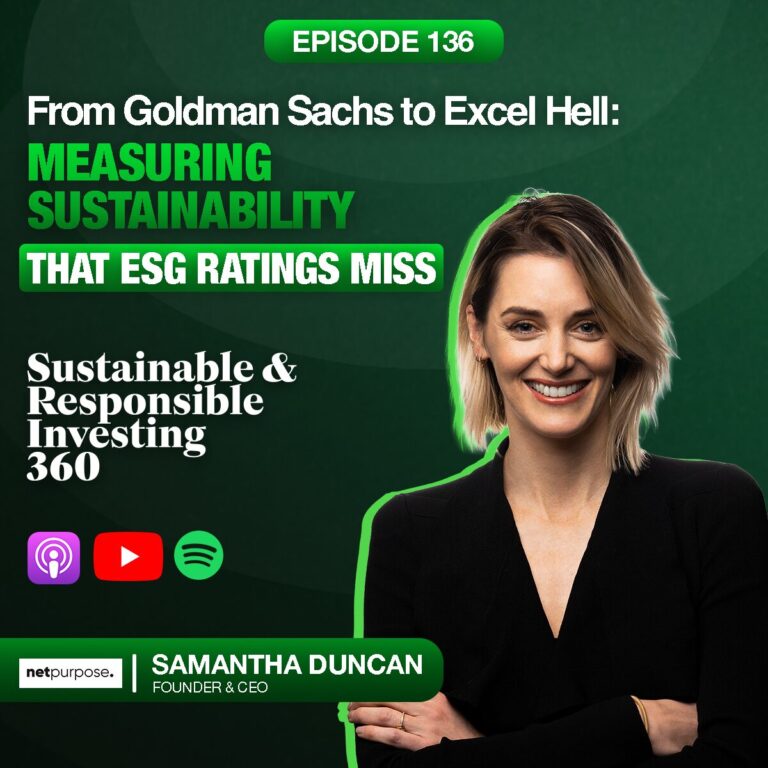
In this episode, I speak with Samantha Duncan, Founder and CEO of Net Purpose, about why ESG ratings don’t measure sustainability, how she built a company to fix that, and the unusual path — Goldman Sachs, Peruvian microfinance, and a graduate degree in international development — that got her there.
Samantha grew up in rural Victoria, Australia, the daughter of an electrical engineer turned chocolate manufacturer and a British-born entrepreneur mother. She studied commerce and finance at the University of Queensland and, after a stint at PwC, joined Goldman Sachs’ healthcare M&A team in Sydney in 2007 — just in time for the global financial crisis.
Inside the bank, she found herself drawn to the real-world stakes of the deals she worked on — transactions that changed the cost of pathology, shut down rural medical centers, and reshaped access to care — while every piece of analysis reduced that complexity to a single metric: earnings per share. Watching that tension play out, alongside the excesses of the era and the headlines around Muhammad Yunus winning the Nobel Prize for microfinance, pushed her to resign and pursue what she vaguely described to former colleagues as “a career in social finance.”
That decision took her to Trujillo, Peru, where she ran a microfinance program for a children’s NGO called SKIP (Supporting Kids in Peru). The program wasn’t working: women weren’t repaying their loans. Samantha discovered the issue wasn’t capability, it was design — the loans had no term and no real incentive to repay.
When she switched the terms to a simple commercial rate, repayment rates flipped almost overnight, and the women told her directly that the charitable terms had felt disempowering, not generous. The experience convinced her that social and commercial outcomes aren’t in tension — they reinforce each other.
From Peru, she went to Johns Hopkins’ School of Advanced International Studies for a master’s in international economics and development, then joined LeapFrog Investments in 2012, eventually becoming Head of Impact. There, she helped build FIRM, one of the industry’s early frameworks for measuring social and financial performance side by side, and contributed to the development of IRIS+, the B Impact Assessment, and other measurement standards used across the impact investing industry.
It was also at LeapFrog that she hit what she now calls “Excel hell”: her team, like most of the industry, was spending the bulk of its time manually extracting numbers from PDFs and punching them into spreadsheets — even as roughly 70% of global capital had signed on to the UN Principles for Responsible Investment. On January 1, 2018, she decided she couldn’t keep doing that work without trying to fix the underlying infrastructure. Net Purpose was registered later that year and launched in 2019.
Net Purpose’s core pitch is simple: “facts, not scores.” Rather than producing a single ESG score the way MSCI or Sustainalytics do, the company collects raw sustainability data — emissions, water use, gender diversity, financial inclusion, and more — directly from corporate disclosures, cross-references it against roughly 1,600 pieces of scientific literature on business activities, and surfaces it to investors with full source transparency. The platform now supports clients managing hundreds of billions of dollars and was recently joined by the SDI Asset Owner Platform, a sustainability data standard built by APG, PGGM, AustralianSuper, and BCI.
We get into the central critique of ESG ratings directly: why McDonald’s could receive a ratings upgrade despite its emissions, why Tesla was removed from the S&P 500 ESG index while ExxonMobil remained, and why Samantha believes these aren’t errors so much as the logical output of a system designed to measure financial risk rather than real-world impact.
We also talk about definitions — what “sustainable,” “impact,” and “ESG” actually mean and why the industry still conflates them — and about a reframe she uses to make the stakes concrete: if only 16% of a global index is genuinely sustainable, that also means 84% of the portfolio is built on resources that won’t exist in ten years. For Samantha, that’s not a sustainability problem; it’s a financial returns problem the industry hasn’t fully reckoned with yet.
What stayed with me after this conversation is how consistently Samantha has chased the gap between what a system claims to measure and what it actually measures — from EPS at Goldman to microfinance repayment terms in Peru to ESG ratings today. Her argument isn’t that ESG is worthless; it’s that we’ve confused a financial-risk tool with a sustainability tool, and that confusion is costing the industry credibility it can’t afford to lose.
This conversation is a reminder that sustainable investing only becomes real when it’s built on facts that can be sourced, checked, and trusted — not scores generated behind a black box. As capital markets work out what comes after the ESG backlash, the firms doing the unglamorous work of building that data infrastructure may end up mattering more than anyone expected.
Listen to the full conversation.
–
Listen to the episode on Apple Podcasts, Spotify, Overcast, Podcast Addict, Pocket Casts, Castbox, YouTube Music, Amazon Music, or on your favorite podcast platform. You can watch the interview on YouTube here.



What was your favorite quote or lesson from this episode? Please let me know in the comments.
SHOW NOTES:
[04:38] Growing up in rural Australia and an entrepreneurial family
[07:50] From a commerce degree at UQ to a stint at PwC
[10:15] Landing at Goldman Sachs in healthcare M&A
[11:10] The yacht, the EPS obsession, and the tension of “peak capitalism”
[14:40] Resigning from Goldman to run a microfinance program in Peru
[20:07] Why charity terms failed and commercial terms worked
[22:17] Johns Hopkins and joining LeapFrog Investments
[26:47] Becoming Head of Impact and building the FIRM framework
[28:44] Deal deep dive: Express Life Ghana and Prudential
[30:31] The case for commercial sustainability over charity
[33:17] Deal deep dive: Bima, Allianz, and the bias against big companies
[35:46] Hitting “Excel hell”
[38:59] January 1, 2018: deciding to build Net Purpose
[42:16] What Net Purpose does and how it differs from an ESG rating
[45:47] The central critique of ESG ratings (McDonald’s, Tesla, ExxonMobil)
[48:58] Defining sustainability, impact, and ESG
[52:45] Do we still need MSCI and Sustainalytics?
[01:00:24] How the data pipeline actually works
[01:04:09] Acquiring the SDI-AOP and aligning the industry on one standard
[01:07:26] Greenwashing, regulation, and the UK’s “improvers” label
[01:14:55] ESG’s political backlash, competitive moat, and the 16% / 84% reframe
[01:23:54] What keeps her moving toward the hardest problems
[01:30:29] Rapid Fire Questions
Additional Resources:
MORE QUOTES FROM THE INTERVIEWS:
“Every investor will be a sustainable investor, over the long term just like every investor is today a financial investor. ”
— Samantha Duncan