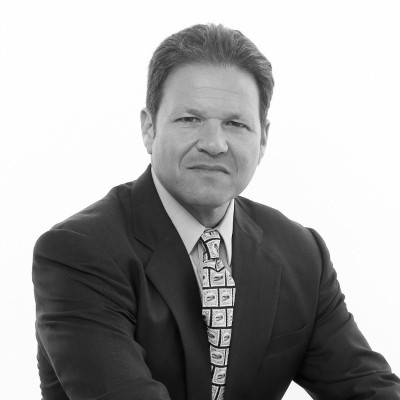
“The mental aspects of golf and investing actually have a lot in common. You have to manage your emotions, focus on what you’re doing, and approach each shot as new and separate from the last one. That ‘goldfish memory’ – the ability to reset and move on – is critical. It’s just you out there, focused on what’s in front of you. ”
— Mark Hays
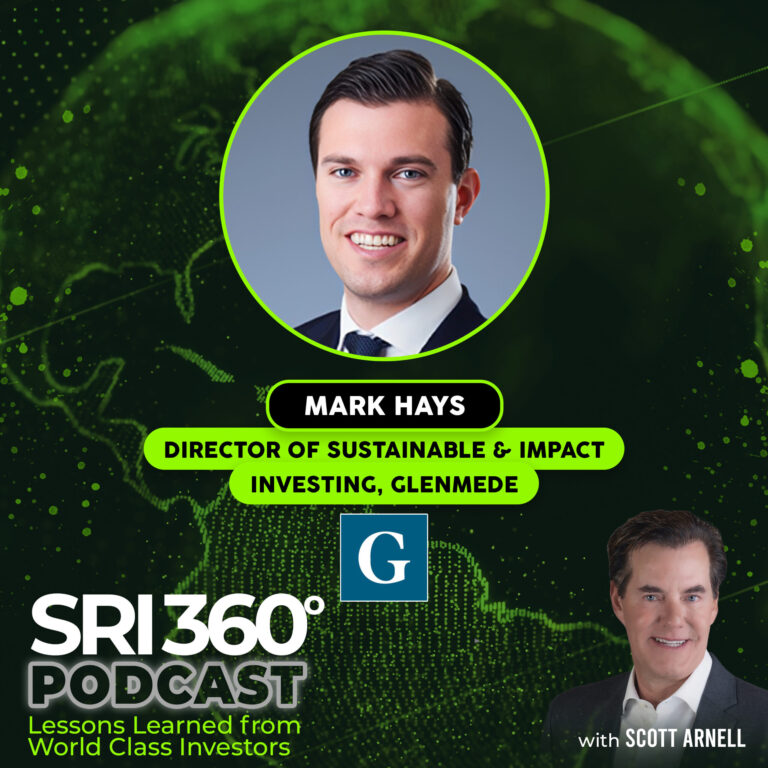
In this episode, I’m talking with Mark Hays, Director of Sustainable & Impact Investing at Glenmede — a Philadelphian who’s been threading the needle between alpha and impact since he was nine years old.
By that time, Mark had already learned what it meant to earn. When he asked for a Sega Genesis, he knew what was coming — not No, but Figure it out. So he set up a lemonade stand and started saving. It wasn’t just pocket money — it was a lesson.
In his family, work was how you got things, and responsibility showed up early, in chore charts and coin jars. That wasn’t punishment. It was permission — to try, to build, to own the outcome.
The markets hijacked his curiosity early.
He still remembers the moment in third grade: standing in front of his class, holding up a chart for a stock project that had gone sideways. Mark picked the children’s book publisher Scholastic. But it dropped nearly 60% over the school year.
He was embarrassed. But also, completely fascinated.
While other kids moved on, he got hooked — not just on the numbers, but on what they revealed. That chart wasn’t just a line. It was a story. And he wanted to know how to read it.
College had to check four boxes — sunshine, sports, distance from home, and a serious investing program — so he chose Wake Forest, where he studied business. There, he co-founded the entrepreneurship club to explore what makes early businesses great — and even brought Steve Wozniak to campus his senior year.
At Cambridge Associates, he got a front-row seat to nearly every asset class, working across portfolios that included venture, private equity, hedge funds, and traditional long-only strategies. But the firm’s early “mission-aligned” work felt more like philanthropy by subtraction — mostly faith-based screens that ruled out whole sectors and, in doing so, shrank both the investment universe and the potential for strong returns.
The big turning point came when Mark was working at OMERS Capital Markets and came across a presentation for an off-grid solar fund in South Africa. The slide showed two types of returns: one was the financial return, and the other was the number of people who would gain access to affordable electricity.
That was the moment it clicked — impact and strong returns didn’t have to be separate. As Mark put it, “If you make impact, the bottom line’s stronger.”
To sharpen his skills, Mark crossed the Atlantic for an MBA at London Business School — then tested both ends of the spectrum: first at Flat World Partners, an advisory and investment firm focused entirely on sustainability and impact, and later at J.P. Morgan Asset Management, where he became the firm’s first U.S. sustainable investing hire.
Getting buy-in from more than twenty seasoned portfolio teams at a trillion-dollar firm wasn’t easy. After a few failed pitches, Mark hit on a new approach: “Don’t let them only hear from me — the ‘ESG guy’.” Instead, he’d pair the ESG lead with a peer they already respected, lead with data that proved “economics before impact,” and build a 25-person Sustainable Investment Leadership Team to carry the message across the firm.
But in 2020, Mark got a call from Glenmede. They wanted him to lead and grow the firm’s sustainable and impact investing platform. The pitch was clear: this was a chance to build something long-term at a privately owned firm that believed impact could be a competitive advantage.
He accepted and still calls it “absolutely the best move we’ve ever made, both personally and professionally.”
Glenmede is an investment and wealth management firm founded in 1956 by the Pew family as the trustee for their family wealth. Today, it offers investment management, wealth planning, fiduciary, and advisory services to high-net-worth individuals, families, endowments, foundations, and institutional clients.
It has $48 billion in assets under management, but keeps a 4-to-1 client-to-employee ratio and promises, in Mark’s words, “the experience of a $200 million family as a $10 million individual.” That approach means every client gets tailored advice, deeper conversations, and impact reporting that goes far beyond ESG scores — often translating raw data into real-world outcomes.
Nearly 20 percent of AUM sits in strategies that fit Glenmede’s four-category investment taxonomy (Integrated, Mandated, Thematic, High-Impact Concessionary) and span almost every asset class. They range from 12-month, 2 percent-interest loans to daycare centers in underserved Philadelphia neighborhoods to public-equity engagements that helped lift Citigroup’s reported gender-pay ratio from $0.62 to about $0.97 on the dollar.
Mark’s through-line is what he calls “sustainable prosperity” — the belief that helping those with the least doesn’t take away from others, but actually creates more opportunity and value for everyone.
At Glenmede, that vision shows up not only in where the money goes but in how clients are engaged. Mark and his team don’t just plug people into products — they guide multi-generational families through deep, often difficult conversations about values, legacy, and measurable impact.
That means starting with inquiry, moving through education, assessment, and implementation, and ending with real measurement — not in vague ESG scores, but in tangible results like gallons of water saved, emissions avoided, or communities reached.
Mark knows that impact is a moving target, but he also knows how to hit it: by staying curious, staying human, and staying honest about what money can and cannot do.
Tune in to hear how he turns that approach into measurable impact.
Listen to the episode on Apple Podcasts, Spotify, Overcast, Podcast Addict, Pocket Casts, Castbox, YouTube Music, Amazon Music, or on your favorite podcast platform. You can watch the interview on YouTube here.



What was your favorite quote or lesson from this episode? Please let me know in the comments.
SCROLL BELOW FOR LINKS AND SHOW NOTES…
ADDITIONAL RESOURCES:
- Connect with Mark: LinkedIn
- Glenmede website
- Glenmede’s 2025 Market Outlook
- Book “Speed & Scale: An Action Plan for Solving Our Climate Crisis Now”, by John Doerr
- Book “The Key Man: The True Story of How the Global Elite Was Duped by a Capitalist Fairy Tale”, by Simon Clark and Will Louch
- As You Sow website
- Use this free tool to see if your investments are sustainable:
Previous SRI360 interviews mentioned:
- Andrew Behar (Ep. 27)
SHOW NOTES:
[00:00] Introduction
[04:11] Mark’s early exposure to work ethic and money values
[06:51] Discovering investing through a stock project in third grade
[09:43] Learning about business through family and entrepreneurship clubs
[11:35] Insights from working at Cambridge Associates
[14:12] Joining OMERS and backing off-grid solar in South Africa
[19:48] Getting an MBA from the London Business School & joining Flat World Partners
[23:34] Mark’s Economics Before Impact philosophy
[28:43] Becoming the first US sustainable investing person in JP Morgan Asset Management
[34:58] Joining Glenmede and building a client-focused impact practice
[37:28] Glenmede – a high-level overview
[42:01] White glove customization
[44:40] Glenmede’s mission and theory of change
[50:25] Aligning multiple generations on investment goals
[58:06] 5-step client engagement process: Inquire, Educate, Assess, Implement, Measure
[01:09:00] Client impact reporting preferences
[01:11:08] Glenmede’s proprietary four-category taxonomy
[01:17:25] Sustainable Investing Advisory Council
[01:20:14] A comprehensive public equity impact fund analysis
[01:34:49] Glenmede’s approach to active ownership and engagement
[01:39:35] ESG backlash management
[01:44:32] Future trends and opportunities – 3 big themes
[01:47:54] Rapid-fire questions
MORE MARK HAYS QUOTES FROM THE INTERVIEW:
“At Glenmede, we like to say you can have the experience of a $200 million family as a $10 million individual. That’s the key difference – what you can expect from us compared to a large-scale peer. ”
— Mark Hays
“When I meet with managers, I always ask: “Why are you using ESG or impact data in your strategy?” A good answer is that the data helps them make better decisions and improve returns. A bad one is: “Younger clients want it, so we offer it.” That’s not investing – that’s marketing. If there’s no clear link between the data and performance, it’s not a double bottom line strategy. ”
— Mark Hays